Introduction
Patellofemoral syndrome (PFS) is a common condition characterized by anterior knee pain, typically located at the front of the knee, which is exacerbated by activities that involve flexion and extension of the knee joint [1]. PFS is estimated to be the most common cause of anterior knee pain in athletic and nonathletic populations. PFS is common in the United States; the incidence is 1.5-7.3% [2]. The syndrome is often attributed to malalignment of the patella, muscular imbalance of lower extremities, overuse, and poor tracking of the patella [3]. The exact etiology is unclear; however, overuse is the most contributing factor to this condition. Most patients’ symptoms resolve with conservative management, but rarely the symptoms are resistant to treatment and persist for years [1].
Case Report
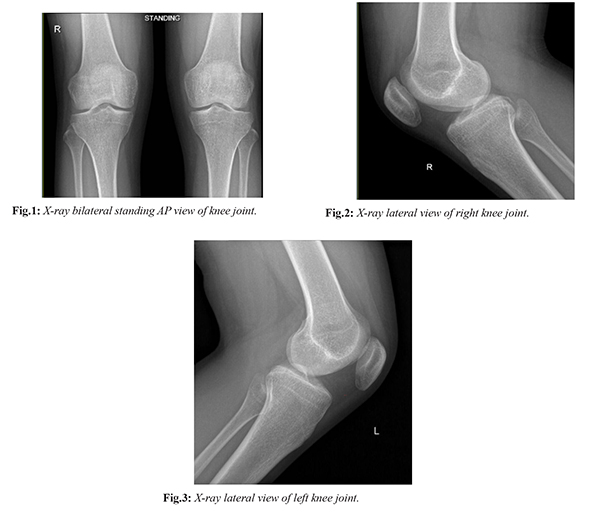
H. A. A., a 24-year-old previously healthy athletic female, presented to our clinic with a 6-month history of bilateral knee pain localized to the anterolateral aspect of both knees. The pain was exacerbated by activities such as squatting, climbing stairs, and walking downstairs. She also reported stiffness and swelling in both knees, particularly after periods of inactivity. She had no history of trauma or previous knee surgery. Physical examination revealed tenderness to palpation over the patellar tendon and patellofemoral joint lines. Range of motion was intact. The patient's quadriceps strength was found to be weak, particularly in the vastus medialis obliquus (VMO) muscle, patellar mal-tracking was noticed in both knees, more on the right side, and both hamstrings were tight. Standing AP [Fig.1], and lateral [Fig.2,3] X-ray views of the knee joints showed that the articular surfaces appear normal with no presence of peri-articular pathology, normal width of joint spaces, no evidence of patellar subluxation, no lucent fracture lines, and no abnormal soft tissue shadows.
Based on the patient's symptoms, physical examination findings, and imaging, a diagnosis of patellofemoral syndrome was made. She was prescribed anti-inflammatory medication (Celecoxib 400 mg) and collagen hydrolysate alpha to reduce inflammation and improve joint health. Magnesium citrate 400 mg was also prescribed to address muscle tightness. The patient was referred to a sport physical therapist for exercises to strengthen her VMO complex. She underwent a comprehensive rehabilitation program that included exercises aimed at improving quadriceps strength, hip alignment, and patellar tracking. These included: single leg extension, tempo squats, banded terminal knee extension, hamstring curls, hip abduction and adduction. The patient’s coach was consulted about her condition and upon his assessment, the following changes were incorporated in her training program. The patient was asked to avoid running uphill and downhill, explosive jumping exercises, and deep squats. Focusing on single leg movements and body balance became a priority in her training program. The patient followed the rehabilitation program and followed her coach’s instructions for 6 months and reported significant improvement in her symptoms.
Despite her initial improvement, the patient still experiences recurrent on-off moderate anterolateral knee pain and stiffness when sitting for long periods. At her latest follow-up visit, 12 months after initial presentation, she reported a persistent tendency for her knees to become stiff after prolonged sitting or standing.
Discussion
Patellofemoral syndrome (PFS) is a multifactorial condition in which symptoms often arise from a combination of biomechanical imbalance, muscular weakness, and repetitive stress on the patellofemoral joint. Although young, active individuals commonly respond well to conservative treatment, a subset like the patient in this case experience persistent or fluctuating symptoms despite appropriate rehabilitation [2,3].
In this patient, bilateral weakness of the vastus medialis obliquus (VMO) was a key contributing factor. Weakness in this muscle can lead to lateral patellar displacement, increased joint stress, and anterior knee pain. While targeted quadriceps and VMO-strengthening exercises remain the standard approach, isolated strengthening may not be sufficient in all cases. The patient also exhibited tight hamstrings and evidence of patellar maltracking, both of which may contribute to abnormal load distribution across the patellofemoral joint. Although the rehabilitation program included hip strengthening and balance work, persistent symptoms suggest that additional biomechanical evaluation such as gait assessment may have provided further insight. Her athletic background likely placed additional stress on the patellofemoral joint through activities such as running, squatting, and jumping. Even after modifying her training program, complete symptom resolution did not occur, indicating that long-term maintenance therapy and continued neuromuscular training may be required. Chronic PFS can also involve altered pain perception or persistent movement patterns that are difficult to correct in a short period.
Conclusion
This case highlights that while conservative measures typically provide relief, persistent PFS may require a more comprehensive, individualized approach addressing the entire lower-extremity kinetic chain. For patients with ongoing symptoms, adjunctive therapies such as patellar taping, orthotics, manual therapy, or more advanced physiotherapy techniques may be considered.
Contributors: MAAR: manuscript writing, patient management; NMAG: manuscript editing, patient management; MK: critical inputs into the manuscript. MAAR will act as a study guarantor. All authors approved the final version of this manuscript and are responsible for all aspects of this study.
Funding: None; Competing interests: None stated.
Acknowledgements: We would like to thank the following for their contribution Dr. Mazen Ibrahim, Dr. Mai Al-Sheimy, Mohammad Al-Ali, Abdulaziz Dalhi, Laleh Sourghali.
References
- Crossley KM, Stefanik JJ, Selfe J, Collins NJ, Davis IS, Powers CM, et al. Patellofemoral pain consensus statement from the 4th International Patellofemoral Pain Research Retreat, Manchester. Part 1: Terminology, definitions, clinical examination, natural history, patellofemoral osteoarthritis and patient-reported outcome measures. Br J Sports Med. 2016;50(14):839-843.
- Willy RW, Hoglund LT, Barton CJ, Bolgla LA, Scalzitti DA, Logerstedt DS, et al. Patellofemoral Pain. J Orthop Sports Phys Ther. 2019;49(9):CPG1-CPG95.
- Thomeé R, Augustsson J, Karlsson J. Patellofemoral pain syndrome: a review of current issues. Sports Med. 1999;28(4):245-262.