|
|
|
|
|
Spermatozoa Survival and its Effect on in Vitro Fertilization
|
|
|
|
Hardik J Sheth, Rohina S Aggarwal, Kajal K Patel, Khushani K Patel, Kunur N Shah, Sumesh D Choudhary Department of Obstetrics and Gynaecology, Institute of Kidney Diseases & Research Centre (IKDRC) and Institute of Transplantation Sciences (ITS), Ahmedabad, Gujarat, India. |
|
|
|
|
|
Corresponding Author:
|
|
Dr Rohina S Aggarwal Email: drrohinaaggarwal@gmail.com |
|
|
|
|
|
|
|
|
Received:
19-MAY-2026 |
Accepted:
24-AUG-2026 |
Published Online:
25-SEP-2026 |
|
|
|
|
|
|
|
Abstract
|
|
|
|
Introduction: Complete fertilization failure may occur following conventional in vitro fertilization (IVF), even in couples with normal semen parameters. This case highlights the importance of sperm survival assessment and backup semen cryopreservation. Case Report: A 27-year-old woman with primary infertility experienced complete fertilization failure following conventional IVF, with no observable spermatozoa survival on day one. Rescue intracytoplasmic sperm injection (ICSI) could not be performed because the patient was unable to provide a fresh semen sample. In a subsequent IVF-ICSI cycle, a 24-hour sperm survival test revealed complete loss of sperm viability. Of the 18 mature oocytes injected, 16 achieved normal fertilization, and 12 good-quality embryos were cryopreserved on day three. Conclusion: Sperm survival assessment and backup semen cryopreservation may help guide insemination method selection and facilitate management of unexpected fertilization failure in selected IVF cases. |
|
|
|
|
|
Keywords :
|
Fertilization, Infertility, Intracytoplasmic Sperm Injection, In Vitro Fertilization, Spermatozoa, Sperm Motility.
|
|
|
|
|
|
|
|
|
|
|
|
Introduction
Complete fertilization failure following conventional in vitro fertilization (IVF) may occur despite normal semen parameters and can cause emotional and financial distress [ 1]. Rescue intracytoplasmic sperm injection (ICSI) is an option to overcome this complication; however, its success depends on sperm availability, timing, and oocyte quality [ 2- 5]. Fertilization failure may result from sperm dysfunction, poor oocyte quality, or laboratory-related factors [ 1, 6]. Delayed rescue ICSI may also affect embryo development and reproductive outcomes [ 6- 11]. This case highlights the importance of sperm survival assessment and backup semen cryopreservation to guide insemination method selection and help manage unexpected fertilization failure.
Case Report
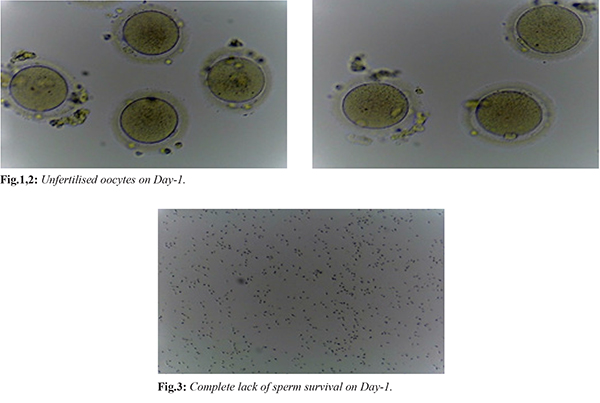
A 27-year-old woman presented with primary infertility following two unsuccessful cycles of ovulation induction combined with intrauterine insemination (IUI). Initial investigations, including semen analysis, revealed normal conventional semen parameters. Based on these findings, the couple was scheduled for IVF using a gonadotropin-releasing hormone (GnRH) antagonist protocol. Controlled ovarian stimulation was initiated with recombinant follicle-stimulating hormone (rFSH) at a dose of 225 IU subcutaneously for seven days, from stimulation day 2 to day 9, followed by 150 IU daily for two additional days, from day 10 to day 11. The GnRH antagonist cetrorelix at a dose of 0.25 mg subcutaneously was introduced on stimulation day 7 and continued for four days. Final oocyte maturation was triggered using recombinant human chorionic gonadotropin (hCG) at a dose of 500 µg subcutaneously on stimulation day 11. Transvaginal ultrasound-guided oocyte retrieval was performed 36 hours after trigger administration, yielding 16 oocytes. The cumulusoocyte complexes (COCs) were inseminated using conventional IVF at a concentration of 150,000 motile spermatozoa per mL of culture medium. The inseminated oocytes were cultured under standard laboratory conditions in center-well dishes covered with mineral oil. Fertilization assessment was performed approximately 18 hours after insemination. None of the oocytes exhibited normal fertilization, as evidenced by the absence of two pronuclei (2PN) and two polar bodies. Furthermore, complete absence of observable spermatozoa survival was noted in the insemination dish. In view of the complete fertilization failure, rescue ICSI was considered after obtaining informed consent. However, the patient was unexpectedly unable to produce a fresh semen sample, making rescue ICSI unfeasible. The couple was counselled regarding the outcome, and a subsequent IVF-ICSI cycle was planned. Fig.1 and 2 show the unfertilized oocytes observed on day 1 following conventional IVF, while Fig.3 illustrates the complete absence of observable spermatozoa survival in the insemination dish on day 1.
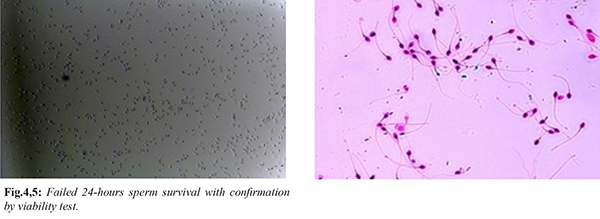
Before initiating the subsequent treatment cycle, the couple underwent repeat baseline assessment, including semen analysis, which again demonstrated normal conventional semen parameters. A freshly collected semen sample was cryopreserved as a backup. In addition, a 24-hour sperm survival assessment was performed and demonstrated complete loss of sperm viability, which was confirmed by a viability test. These findings indicated that conventional IVF might not be an appropriate insemination method despite the apparently normal baseline semen analysis. Accordingly, ICSI was selected for the subsequent treatment cycle. Fig.4 and 5 demonstrate the loss of sperm viability following 24-hour incubation, confirmed by the sperm viability assessment.
Ovarian stimulation during the second cycle was performed using recombinant FSH at a dose of 150 IU subcutaneously for nine days, beginning on stimulation day two. Cetrorelix at a dose of 0.25 mg subcutaneously was administered from stimulation day 7 through day 11. Final oocyte maturation was triggered with recombinant hCG at a dose of 500 µg on stimulation day 11, followed by transvaginal ultrasound-guided oocyte retrieval 36 hours later. A total of 22 oocytes were retrieved. Oocyte denudation was performed 2-3 hours after retrieval to assess maturity, and 18 oocytes were identified as metaphase II (MII) oocytes and underwent ICSI. The injected oocytes were subsequently cultured under standard laboratory conditions in center-well dishes covered with mineral oil. Fertilization assessment approximately 18 hours after ICSI demonstrated normal fertilization, characterized by the presence of two pronuclei and two polar bodies, in 16 of the 18 injected oocytes, corresponding to a fertilization rate of 89%. The fertilized oocytes were cultured further for embryo development. On day three, ten embryos had reached the eight-cell stage and six embryos had reached the six-cell stage, with all 16 embryos reported to be of good quality. Twelve embryos, comprising six eight-cell embryos and six six-cell embryos, were cryopreserved. The remaining four embryos were cultured further but unexpectedly failed to reach the blastocyst stage by day five. These findings demonstrated that ICSI successfully achieved fertilization in the subsequent cycle despite the documented loss of sperm viability during the 24-hour survival assessment. However, the absence of blastocyst development among the remaining embryos indicated that successful fertilization did not guarantee progression to the blastocyst stage.
Discussion
Successful fertilization depends on the interaction between spermatozoa and oocytes. Complete fertilization failure following conventional in vitro fertilization (IVF) can cause significant psychological distress and financial burden for infertile couples. Rescue intracytoplasmic sperm injection (ICSI) may be considered to overcome this complication and achieve fertilization, although subsequent embryo development is not guaranteed [ 2- 5]. At our center, complete fertilization failure occurs in approximately 5-10% of conventional IVF cycles. Conventional IVF is preferred in suitable cases to allow natural sperm–oocyte interaction and selection under optimal laboratory conditions. However, ICSI is preferred in cases involving male-factor infertility or previous IVF fertilization failure. As demonstrated in this case, ICSI may become the only available option when sperm survival is compromised and conventional IVF fails. Therefore, in patients with normal semen parameters who are planned for conventional IVF, a 24-hour sperm survival assessment and cryopreservation of a backup semen sample may help guide the choice of insemination method and provide an alternative when unexpected fertilization failure occurs.
Conclusion
This case highlights that normal semen parameters do not necessarily predict sperm survival under IVF culture conditions. A 24-hour sperm survival assessment and backup semen cryopreservation may help guide the choice of insemination method and reduce the risk of unexpected fertilization failure.
Contributors: HJS, RSA: found the concept and participated in writing; KKP, KKP: revised and approved the final manuscript; KNS, SDC: participated in writing. RSA will act as a study guarantor. All authors approved the final version of this manuscript and are responsible for all aspects of this study. Funding: None; Competing interests: None stated.
References - Chen HL, Copperman AB, Grunfeld L, Sandler B, Bustillo M, Gordon JW. Failed fertilisation in vitro: Second day micromanipulation of oocytes versus reinsemination. Fertil Steril. 1995;63:1337-1340.
- Kuczynski W, Dhont M, Grygoruk C, Pietrewicz P, Redzko S, Szamatowicz M. Rescue ICSI of unfertilized oocytes after IVF. Hum Reprod. 2002;17:2423-2427.
- Lombardi E, Tiveron M, Inza R, Valcarcel A, Young E, Bisioli C. Live birth and normal 1-year follow-up of a baby born after transfer of cryopreserved embryos from rescue intracytoplasmic sperm injection of 1-day-old oocytes. Fertil Steril. 2003;80:646-648.
- Nagy ZP, Joris H, Liu J, Staessen C, Devroey P, Van Steirteghem AC. Intracytoplasmic single sperm injection of 1-day-old unfertilized human oocytes. Hum Reprod. 1993;8:2180-2184.
- Yuzpe AA, Liu Z, Fluker MR. Rescue intracytoplasmic sperm injection (ICSI)-salvaging in vitro fertilization (IVF) cycles after total or near-total fertilization failure. Fertil Steril. 2000;73:1115-1119.
- Pehlivan T, Rubio C, Ruiz A, Navarro J, Remohi J, Pellicer A, et al. Embryonic chromosomal abnormalities obtained after rescue intracytoplasmic sperm injection of 1-day-old unfertilized oocytes. J Assist Reprod Genet. 2004;21:55-57.
- Chen C, Kattera S. Rescue ICSI of oocytes that failed to extrude the second polar body 6 h post-insemination in conventional IVF. Hum Reprod. 2003;18:2118-2121.
- Huirne JA, Hugues JN, Pirard C, Fischl F, Sage JC, Pouly JL, et al. Cetrorelix in an oral contraceptive pretreated stimulation cycle compared with buserelin in IVF/ICSI patients treated with r-hFSH: A randomized, multicentre, phase IIIb study. Hum Reprod. 2006;21:1408-1415.
- Palermo G, Joris H, Devroey P, Van Steirteghem A. Pregnancies after intracytoplasmic injection of single spermatozoon into an oocyte. Lancet. 1992;340:17-18.
- Leniaud L, Poncelet C, Porcher R, Martin-Pont B, Cedrin-Durnerin I, Hugues JN, et al. Prospective evaluation of elective single-embryo transfer versus double-embryo transfer following in vitro fertilization: A two-year French hospital experience. Gynecol Obstet Fertil. 2008;36:159-165.
- DeUgarte CM, Li M, Jordan B, Hill D, DeCherney A, Surrey M. Rescue intracytoplasmic sperm injection and preimplantation genetic diagnosis in combination can result in pregnancy. Fertil Steril. 2006;86(1):200-202.
|
|
|
|
|
|
|
Search Google Scholar for
|
|
|
Article Statistics |
|
Sheth HJ, Aggarwal RS, Patel KK, Patel KK, Shah KN, Choudhary SDSpermatozoa Survival and its Effect on in Vitro Fertilization.JCR 2026;16:70-73 |
|
Sheth HJ, Aggarwal RS, Patel KK, Patel KK, Shah KN, Choudhary SDSpermatozoa Survival and its Effect on in Vitro Fertilization.JCR [serial online] 2026[cited 2026 Nov 21];16:70-73. Available from: https://www.casereports.in/articles/16/3/Spermatozoa-Survival-and-its-Effect-on-in-Vitro-Fertilization.html |

|
|
|
|
|