Introduction
Dengue fever is a common viral infection with variable clinical manifestations, including cardiac involvement. Cardiac abnormalities may range from transient bradycardia to myocarditis and may remain unrecognized without ECG monitoring [
1]. Proposed mechanisms include viral invasion, inflammation, and altered calcium homeostasis. Most ECG abnormalities are transient and resolve spontaneously [
2]. We report a case of transient AV conduction abnormalities in an 8-year-old child with dengue fever.
Case Report
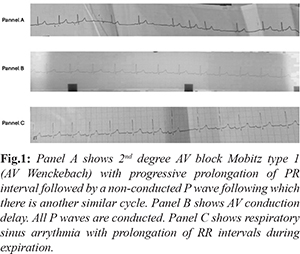
An 8-year-old boy with normal growth and development and no significant previous illness presented on the fifth day of illness with high-grade fever, vomiting, and an erythematous non-pruritic rash. He was hemodynamically stable with good urine output and no petechiae; however, an irregular cardiac rhythm was noted. Hemogram revealed thrombocytopenia, and dengue NS1 antigen was positive. ECG showed AV conduction delay, intermittent Mobitz type I second-degree AV block (AV Wenckebach), and intermittent junctional rhythm. The child was managed with close observation, vital monitoring, and serial ECGs. He became afebrile the next day, while the conduction abnormalities persisted initially. By day 3, the rhythm became regular with first-degree AV block, and by day 4, only respiratory sinus arrhythmia remained, following which he was discharged. Follow-up at 1 week, 1 month, and 6 months showed normal sinus rhythm without persistent AV conduction delay. On ECG, Panel A demonstrated Mobitz type I second-degree atrioventricular (AV) block, characterized by progressive PR interval prolongation followed by a non-conducted P wave. Panel B showed AV conduction delay with preserved conduction of all P waves to the ventricles. Panel C demonstrated respiratory sinus arrhythmia, with prolongation of the RR intervals during expiration [Fig.1].
Discussion
Cardiac manifestations in dengue fever are variable and may frequently go unrecognized. In a rural tertiary care centre study, cardiac manifestations were reported among patients with dengue, highlighting that cardiac involvement may accompany the systemic manifestations of the infection [
1].
The spectrum of cardiac involvement in dengue ranges from relatively mild and transient abnormalities, such as bradycardia, to more severe manifestations including myocarditis [1]. The presence of conduction abnormalities in the present child, despite hemodynamic stability and absence of other significant abnormalities, illustrates the possibility of transient cardiac electrical involvement during acute dengue infection. Electrocardiographic abnormalities associated with dengue have been described in the literature, although these abnormalities are better characterized in adult series than in children [2]. The abnormalities reported include changes in cardiac rhythm and conduction, supporting the importance of ECG evaluation when cardiac involvement is suspected. Several mechanisms have been proposed for electrophysiological abnormalities in dengue. These include direct viral invasion, inflammation, and alteration of calcium homeostasis [2]. Such mechanisms may contribute to disturbances in impulse generation or conduction during the acute phase of infection. However, the exact mechanism responsible for the transient AV conduction abnormality in an individual patient cannot be established solely from the clinical and ECG findings. An important feature in this case was the progressive spontaneous resolution of the conduction abnormality. The patient initially had intermittent Mobitz type I AV block and junctional rhythm, followed by first-degree AV block, and subsequently only respiratory sinus arrhythmia. Complete resolution of the AV conduction delay was documented during follow-up at 1 week, 1 month, and 6 months. This clinical course is consistent with the observation that most electrophysiological abnormalities associated with dengue are transient and resolve spontaneously [2]. The case also emphasizes the value of serial ECG monitoring. A single ECG may not capture intermittent conduction abnormalities such as Mobitz type I AV block or junctional rhythm. In a child with dengue fever and an irregular rhythm, ECG assessment and continued monitoring can therefore help identify transient conduction disturbances and document their resolution.
Conclusion
Dengue fever can be associated with transient cardiac conduction abnormalities, including AV conduction delay, Mobitz type I second-degree AV block, and junctional rhythm. In this child, the abnormalities resolved progressively with recovery from the acute illness, with no residual AV conduction defect during 6 months of follow-up. The case highlights the importance of recognizing possible cardiac involvement in dengue and performing serial ECG monitoring when an abnormal rhythm is detected. Most electrophysiological abnormalities reported in dengue are transient and may resolve spontane-ously [2].
Contributors: AMN: selected the case and prepared the document; JR: data collection. AMN will act as a study guarantor. Both the authors approved the final version of this manuscript and are responsible for all aspects of this study.
Funding: None; Competing interests: None stated.
References
- Poornima H, John J. Cardiac manifestations in dengue patients in a rural tertiary care centre in coastal Kerala. Int J Innov Res Med Sci. 2019;4(4):302-303.
- Parchani A, Krishnan VS G, Kumar VKS. Electrocardiographic Changes in Dengue Fever: A Review of Literature. Int J Gen Med. 2021;14:5607-5614.